Vmware Tool For Mac Os X Download
- OS X Unlocker essentially patches the installed VMware product so Mac OS X can be installed. It does this modifying some core VMware system files. Browse to the folder where you extracted OS X Unlocker and Run the following files As Administrator ( win-install.cmd and win-update-tools.cmd ).
- Then you are in the right place because here I am wanna show you how to install VMware tools on macOS Sierra. If you install it then you OS X 10.11 Will work perfectly with the VMware. Actually, when you install Vmware tools on OS X 10.11 then it will install the missing drivers and kext when you installed it then your macOS Sierra works perfectly.
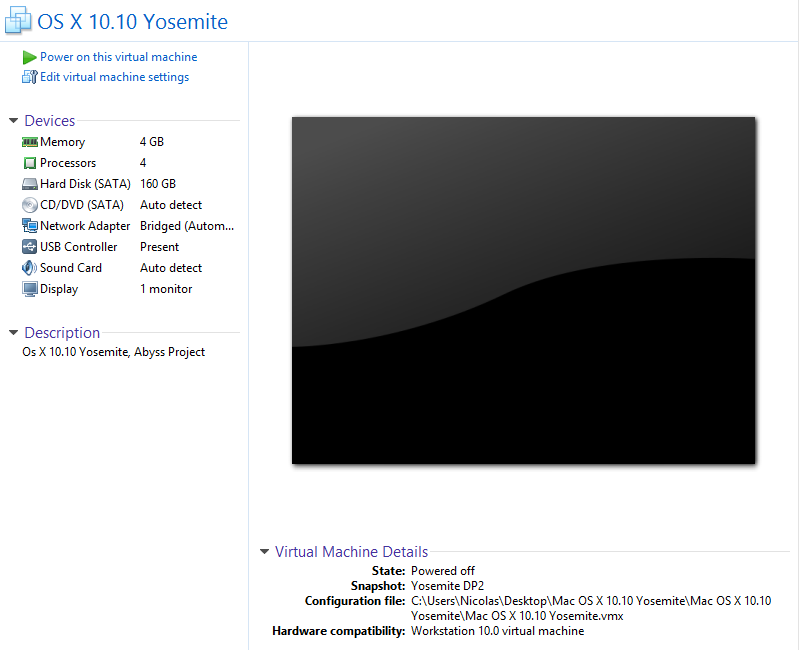
- How to install Mac OS X Yosemite on VMware. It's really great that we can use OS X operating system on our non-Mac computer. Of course, there is a way to build a Hackintosh PC but you may need to upgrade your computer, so install an OS X as the virtual machine is much better.
I'm not dismissing the fact that you are having issues, and that is unfortunate, but I don't believe these are systemic issues, but are specific to your environment. Because in reality, if these issues were systemic, then MANY more users would be experiencing the same, and we'd hear about it, more importantly VMWare would likely be able to reproduce it and thus fix it.
Some suggestions before you give up on Fusion...., create a new partition on your drive or get an external drive, and do a fresh install of whatever macOS you use on the new partition or external drive. Your 'regular' working system won't be at risk at all. AFter the fresh install of macOS, don't install any other apps, add ons, tweaks etc, don't change or add anything, just install Fusion, that's it, and load a saved VM image. If no errors, then something about your everyday working system may be causing the errors. If you get the same errors, then possibly the VM image(s) you use are corrupted. To confirm that, install a new one virtual machine, like a copy of macOS or Windows from scratch. Don't worry about activation, you just want to test if it runs. If no issues, then that suggests your working images might be corrupted, either literally in the file image itself, or internally in the operating system running within the VM.
These are just suggestions, peace, and good luck.
As part of working with OS X VMs in VMware Fusion and ESXi, I’ve regularly installed the VMware Tools and have even found ways to incorporate their installation into my build process. However, getting the latest VMware Tools installer into my VM building workflow has usually involved at least one manual step or having a system management tool handle the installation for me. I wanted something that was completely automated without needing to also install a system management client. My end goal was that I didn’t have to worry about doing anything; the latest VMware Tools for my OS X VM would just be installed into the VM as part of the build process.
MacOS, the operating system previously known as Mac OS X, is beautiful, stable, and typically attached to a $1000+ MacBook / iMac. If we want to run macOS on a Windows PC, without the very particular hardware required for Hackintosh, a Mac OS X virtual machine is the next best thing. Oct 23, 2017 macOS, the operating system previously known as Mac OS X, is beautiful, stable, and typically attached to a $1000+ MacBook / iMac. If we want to run macOS on a Windows PC, without the very particular hardware required for Hackintosh, a Mac OS X virtual machine is the next best thing. Vmware free download - VMware Fusion, Macindows, vmCLIpboard, and many more programs. Apple Mac OS X Snow Leopard. The Best Video Software for Windows The 3 Free Microsoft Office Photo. This article details the procedure to install VMware Tools in a guest running macOS. For more information about VMware Tools, see Overview of VMware Tools for VMware Fusion (1022048). Note: macOS guests are only supported in VMware Fusion virtual machines.
After doing some research and testing, I have a solution that looks like it does just that. For more details, see below the jump.
My colleague Joe Chilcote had adapted using AutoPkg to install Puppet Labs‘ Puppet and Facter tools into VMs, using the script available from the link below:
Update – 5-10-2016: Joe let me know that his script was a fork of Tim Sutton‘s Puppet / Facter installation script, so credit to Tim for the original idea.
My colleague Jesse Peterson had written a VMware Tools provider for AutoPkg, which was designed to download the latest copy of VMware Tools for OS X:

I had already used Jesse’s AutoPkg provider to build AutoPkg recipes to download, uncompress and extract the VMware Tools installer, so I decided to see if I could leverage Joe’s technique with my existing VMwareTools.pkg recipe for AutoPkg. I also wanted to make sure to clean all AutoPkg-related parts from the system, as I didn’t want to leave traces behind on what could otherwise be a completely unconfigured OS X VM. After some work, I have a script which does the following:
- Downloads AutoPkg from GitHub using git.
- Adds the AutoPkg recipe repo containing the VMwareTools .download and .pkg recipes
- Redirects the AutoPkg cache to a temp location.
- Downloads the current release version of VMware Tools for OS X using AutoPkg and extracts the installer package.
- Installs the latest VMware Tools using the AutoPkg-generated installer package.
Post-installation
Once VMware Tools has been installed by the script, the OS X VM where VMware Tools has been installed must be restarted in order to enable VMware Tools’ functionality.
Notes
One thing I found in my testing is that git would be needed for this process, so an essential pre-requisite for running this script is installing git.
Vmware Tools For Mac Os X 10.9 Download
This can be most easily accomplished by installing Xcode or the Xcode command line tools (CLT). Both will include git, so installing either should work. One gotcha I ran into during my testing is that Xcode / Xcode CLT usually require accepting Apple’s license before you’ll be able to use git, so make sure the license has been accepted prior to running this script.
I’ve posted the script to my GitHub repo at the following address:
Vmtools Mac
This script is also available as a payload-free installer package, stored as a .zip file in the payload_free_installer directory.