Using A Mac Scan Tool For Misfire Counter
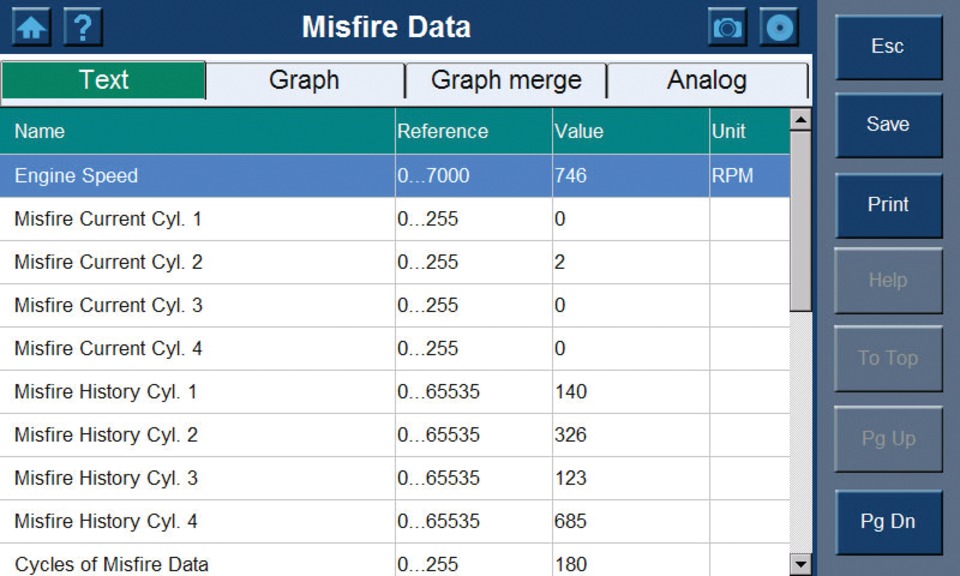
Scanning to Detect Misfires Very specialized video goes very in-depth into how to use the scan tool to detect misfires. The scan tool is the window into the ECM. DIAGNOSING MISFIRES. Misfire is a common driveability problem that may or may not be easy to diagnose, depending on the cause. A misfiring cylinder in a four-cylinder engine is, pardon the pun, hard to miss. The loss of 25% of the engine's power output is the equivalent of a horse trying to run on three legs. USING A SCAN TOOL. The scan tool can monitor the Misfire Index. There is a current and history misfire counter for each cylinder. Use the current misfire counter in order to determine which cylinder is misfiring or use the history misfire counter for misfires that are not currently present. If a misfire is present and you suspect a fuel control condition, force the fuel system into Open Loop using the scan tool and allow the engine to run for a few minutes. If this eliminates the misfire, refer to any fuel control related DTCs which are set.
- Using A Mac Scan Tool For Misfire Counter Scan Tool
- Mac Taskmaster
- Mac Taskmaster Scan Tool
- Using A Mac Scan Tool For Misfire Counters
- Mac Scan Tool
- Mac Scan Tool Bluetooth
Tools used:
- Vehicle Information Source
- Diagnostic Worksheet
- Scan Tool
In this tool briefing, we are going to discuss the tools and strategies necessary to diagnose the cause of misfires. Since misfires can have many different causes, we will split up the article into three segments and deliver them over the next few PTEN issues. In this month’s article, we will focus on how to easily determine what type of misfire is occurring; mechanical, fuel, or ignition. We will also look at the three primary tools necessary to determine the cause' vehicle information, scan tool information and obtaining information from the customer.
Step 1 – Obtaining Vehicle Specific System Information
Since auto manufacturers utilize differing methods to determine when a misfire is occurring, it is necessary to understand the conditions that cause the DTC to set for that particular vehicle. Knowing what conditions are used to set a DTC will allow the tech to have a better understanding of the strategy the manufacturer uses to determine if a misfire is occurring. Using the information provided from a vehicle information source, such as Mitchell ProDemand, can provide you with not only the conditions necessary to set a DTC, but what conditions can cause a misfire DTC to not set, even if you feel one while you are diagnosing the vehicle.
Let’s start with the reason misfire monitoring is part of OBD-II. The Federal Government mandated in 1996 that vehicle manufacturers notify the driver if a catalyst damaging event is occurring or if emissions were exceeding the FTP (Federal Test Procedure) by 1-1/2 times. Monitoring for misfires can result in both notification of pending catalyst damage or higher emissions.
It is up to the vehicle manufacturer how to determine if a misfire is occurring that will cause the FTP threshold to be exceeded. Because of this, there is not a one-size-fits-all type of strategy to approach misfire diagnosis. For example, most vehicle manufacturers utilize crankshaft speed signals to determine if a misfire is occurring. If the crankshaft speed slows between cylinder firings, it is assumed a cylinder did not have the same combustion rate and therefore is misfiring. Many manufacturers disable the monitor if the ABS or Traction Control System is active because a rough road can cause a tire to bounce on the road, changing crankshaft speed similar to a misfire. Not all vehicles will do this. We once had a 2009 Toyota Sienna with misfire codes in the shop that, according to the freeze frame data, would only misfire on the first trip of the day. After many diagnostic tests and trips attempting to duplicate the issue, we were unable find a cause. With some research we found a TSB that suggested that a tire severely out of balance could set a misfire DTC. In this case when the tires were cold, they vibrated enough to cause engine speed changes that simulated what the PCM strategy determined to be a misfire. If this vehicle used ABS sensor inputs to disable the misfire monitor, a code would not have set. Understanding the system as well as determining if any TSBs are available can save a lot of time.
Step 2 – Obtain Information from the Customer
I teach a lot of technical classes, and one of my favorite questions to ask technicians is “What should be the first step in your diagnostic procedure?' I get many answers, but not many techs give the correct one, which is “Duplicate the Customer’s Concern.' Using a diagnostic worksheet that utilizes information obtained from the driver of the vehicle will give you details that may not be available even from a seasoned technician with the best scan tool. Not understanding what is occurring when the customer experiences the issue can not only add time to the diagnostic process, but may even cause an incorrect or incomplete repair.
A good diagnostic worksheet will also help lead the technician through a complete diagnostic strategy that reduces the likelihood of overlooking a simple solution to the cause of the misfire. The Diagnostic Worksheet, as seen in the sample, can be utilized in the shop to remind technicians to test the basics like battery voltage, fuel pressure, and engine vacuum. All of these items that are easily overlooked because the tech assumes they are okay. It can also be used as a piece of information that can be filed with the repair order, as well as shared with the customer to “justify” the cost of performing diagnostic testing by showing them all of the items that were tested.
Step 3 – Choosing the Correct Tool
Using A Mac Scan Tool For Misfire Counter Scan Tool
Once you understand what the vehicle uses to determine if a misfire is present and obtained enough information from the driver, it is time to get more information. I typically use a code reader to start my diagnostic process. Using a code reader, I can quickly get a lot of information, allowing me to choose the correct tools to continue the diagnostic process. In some cases, it may be quicker to use a manufacturer specific scan tool rather than an aftermarket scan tool. Many of the “factory” scan tools provide great information, but they can be much slower than an aftermarket scan tool. Mode $06 can provide very useful information to diagnose misfires as well as confirm the repair, but many factory tools do not provide Mode $06 data.
Mac Taskmaster
Step 4 – Using the Scan Tool
Once you determine which scan tool you will use, it is important to gather information that will assist in the diagnosis as efficiently as possible. The “old days” of just looking at codes are pretty much gone with the advent of CAN bus systems. In addition, most of the newer aftermarket scan tools now provide a lot of valuable information and also are much better at enabling bi-directional controls of components. We will focus the rest of this article on how to maximize the value of your scan tool to assist in diagnosing the type of misfire that is occurring. One of the first things you should look at now is a complete Network Check, or as some scan tools call it, a “Health Check.” The value of this is not only getting a clear picture of all the computer modules seeing if any codes are present, but checking for “U” codes. A “U” code indicates a loss of communication between modules and, in many cases, can lead you directly to an issue. For example, most vehicle manufacturers will disable the misfire monitor when the fuel level is below 1/8 of a tank. It would be possible to feel a misfire when there are no misfire codes present, if the fuel level sensor cannot communicate due to a CAN communication issue, the misfire monitor will be disabled, therefore not allowing a misfire DTC to set. So if there were a “U” code for a Rear Integration Module present, the Fuel Sender could not provide information to the PCM, disabling the misfire monitor. Repairing the “U” code first, would enable the monitor and allow a DTC to set, pointing to which cylinder is having an issue.
There are many other functions the scan tool can perform, but the order you do them can save time down the road. Many technicians will clear the codes after obtaining them, but you need to remember that when you clear codes, you also erase Freeze Frame Data, reset Adaptive Strategies and reset the Monitor Status. Let’s address the value of each. Freeze Frame Data can provide you with information the PCM was receiving at the time a DTC was set. If it is erased, you lose valuable information of what the sensors were reporting and the information necessary to drive the vehicle under the same conditions that created the misfire.
Resetting the Adaptive Strategy allows both Short (STFT) and Long (LTFT) Term Fuel Trims to return to their baseline. Fuel trim data allows the technician to understand how fuel is being burned in the combustion chamber and how the PCM is compensating for it. Observing Fuel Trim on each bank can give additional clues as to which cylinder, or bank of cylinders, is having the issues. Fuel Trim can also be used to see if there is a vacuum leak causing the misfire. If you noted a LTFT value of +25 percent at idle, and +4 percent it would indicate a vacuum leak, requiring more fuel at idle, but not effecting the required fuel mixture as much at higher RPM’s.
Obtaining the status of each monitor can also assist in determining what could be causing a misfire. The value of looking at the status of the monitors is twofold. First and foremost, seeing which monitors have not completed can assist in understanding some of the data stream information better. For example, if the fuel monitor has not yet run, Fuel Trim corrections in the data stream may not help in the diagnosis. Additionally, providing the monitor status to the customer and advising them that all of the PCM’s “Self- Tests” have not yet completed and if the check engine light comes on shortly after your repair it does not mean the same issue is present.
Next in line would be looking at Mode $06 data. Mode $06 is typically found in the scan tool’s OBD Generic test functions. MODE $06 data consists of raw data that is provided to the PCM from various non-continuously monitored components, such as misfire. Looking at mode $06 data can provide you with an ongoing count of how many misfires are occurring on each cylinder. This information is not only valuable to determine which cylinder is misfiring, but can be used to confirm the vehicle has been repaired properly. Some older scan tools did not easily provide mode $06 data easily, but the newer tools on the market have improved significantly not only the ease of obtaining the data, but in translating the hexadecimal raw data into easily understood information.
Lastly, let’s look at the data stream information useful to determine the cause of a misfire. It is important to keep in mind that the data displayed on tour scan tool is digitized. That means depending on how many PIDs are being displayed, the data you are seeing may not actually be “live” pieces of information. Basically, the more PIDs you are looking at, the slower the information will be updated to the scan tool. This is also important to understand if you are observing graphs such as Oxygen Sensors. The information updates much slower and is very different from what you would see on a lab scope. Looking to see if the cam and crank signals are synched can also be useful, in some cases if they are not in synch, misfire detection will not be enabled. Observing Oxygen Sensor data and fuel trims are key in understanding what type of misfire is occurring. If the system is indicating a lean condition, then focusing on fuel delivery issue would be the most direct approach. Observing MAP Sensor fluctuations could indicate mechanical failures causing the misfire. Note the battery voltage to make sure it is sufficient to deliver enough current to operate the ignition and fuel systems. Many newer vehicles now have PIDs for current on each fuel injector or ignition coil. If this data is available, it can be used to determine if there is a specific issue on an individual cylinder. Another PID that you should check is to see if any injectors are disabled. Since OBD-II requires limiting emissions, many vehicle manufacturers will disable fuel injectors once a misfire is detected, this is done so as to not put unburned fuel into the catalytic converter, possibly damaging it. Looking to see if an injector has been disabled by the PCM can prevent lost time looking at a non-functioning injector, as the cause of a misfire when it may be due to ignition or mechanical issues, but the injector has been turned off by the PCM and will remain off until the misfire code has been cleared.
In the next two articles, we will combine information gained from the scan tool, diagnostic worksheet, and the vehicle information and use it to guide you through a quick diagnostic process using more advanced tools such as lab scopes, pressure/vacuum transducers, and other methods to determine the direct cause of a misfire.
CUSTOMER CONCERN:
Vehicle misfires
VEHICLE APPLICATIONS:
2006 Scion xB
Tests/Procedures for C.O.P. ignition diagnostics:
Mac Taskmaster Scan Tool
- Use a scan tool to check which cylinder is setting the DTC.
- If possible, use misfire counter on Mode 6 or in the OEM enhanced section of the scan tool to count misfires per cylinder.
- Test the suspect ignition coil using a labscope or C.O.P. tester.
- Swap coils and see if the misfire changes cylinders.
TOOLS USED:
- Scan tool
- Labscope
- Compression gauge
- Wiring diagrams
- C.O.P. tester
Fuel injectors do not go bad like they used to and engines routinely last 200,000 miles when maintained properly. Usually, when a misfire occurs on a vehicle these days, the easy assumption to make is to replace the coil in the cylinder setting the misfire DTC.
However, the PCM might misinterpret the CKP sensor and set a misfire DTC for the wrong cylinder. Furthermore, bad engine compression and irregular injectory spray patters can affect ignition in the cylinder.
Thankfully, with the right tools and techniques, ignition misfires can be diagnosed with almost 100 percent certainty rather quickly.
2006 Scion xB bad ignition coil
Unlike Fords, Toyotas are not quite so notorious for bad ignition coils. So, when one of these vehicles rolls into the shop with a misfire, you probably assume the vehicle needs spark plugs. This is because customers presume their Scions are like most other vehicles and only need spark plugs once every 100,000 miles, as opposed to 30,000 miles such as their factory maintenance schedules call for.
What do you do if after the 'tune up' the misfire remains? The following steps cover how to quickly discern the cause of the misfire.
1. Check which cylinder is misfiring
Using a scan tool, check the misfire DTC. Depending on the scan tool (and vehicle) you might be able to count misfires using Mode 6, as seen in Fig. 1. On some vehicles, a relative compression, cylinder power balance and fuel injector flow test can be done with a click of a button. These tests help the technician quickly find out which cylinder is misfiring and depending upon the bidirectional controls offered by the scan tool, narrow down if the misfire is caused by an ignition, fuel or mechanical issue.
2. Test the suspect ignition coil
Testing ignition coils is an uncomplicated process, though ignition waveform interpretation can be quite complicated. For reasons of space, we are not going to discuss every nuance of interpretting an ignition waveform. Instead, we will cover both the old school and new school in ignition diagnostics.
Old school. You will need a labscope, wiring diagram and a T-pin to diagnose ignition the old school way. With the vehicle off, use a wiring diagram to find out which wire on the harness is the ground to the ignition coil, such as that in Fig. 2. Then, simply slide the T-pin into where the ground wire merges into the connector. (See Figs. 3A and 3B.)
It should be noted that if you do not have access to an accurate wiring diagram, simply keep putting the T-pin into a different wire until you get an ignition signal with the vehicle running. You will get a waveform on both the ground and power sides of the ignition circuit, so it is a matter of preference which side you choose.
Using A Mac Scan Tool For Misfire Counters
Do this to each coil using different leads so you can compare ignition waveforms from different ignition coils. The more channels your labscope has, the better.
As Figs. 4 to 6 show, an ignition waveform looks different on different OEM applications. However, you generally do not need to memorize a known good waveform. A bad coil will simply stick out like a sore thumb, looking different than the other ignition coils. Even in Figs. 7 to 8, where not a single coil looks alike, the one that was misfiring has much more voltage and it matches up with the msifire DTC on the scan tool.
It is important to note that when looking at an ignition waveform, the large spike in the beginning of the waveform is the firing voltage. On a current waveform, the waveform will be at its lowest point, because as voltage increases amperage falls.
Mac Scan Tool
The long line of voltage follwing the firing voltage is the firing time, which is the time elapsed when the spark is actually occurring. Differences in firing voltage and other parts of the waveform reflect conditions in the cylinder.
Mac Scan Tool Bluetooth
New school. Don't feel like looking up wiring diagrams or hooking stuff up? Simply use a GTC SmarTach+ COP tester. (See Figs. 9 and 10.) By placing its probe on the top of an ignition coil, it instantly gives an engine RPM, burn time and coil kV reading. So, instead of comparing waveforms, you simply comprare burn time and coil kV between coils.
This method can also be used to check misfirng cylinders on vehicles that use spark plug wires. The probe can be pointed at different spark plug wires. All the technician needs to do is compare results.
3. Swap coils and test again.
It is important to note that regardless of whether you are diagnosing ignition the old or new school way, ignition is always affected by conditions in a cylinder. So, low cylinder compression from a washed down cylinder can make a good coil look bad. (See Fig. 11.)
Simply swap a known 'good' coil with the suspect one, and check again your readings. If the misfire changes cylinders, simply replace the suspect ignition coil. If it doesn't, the vehicle has a fuel or mechanical problem in that cylinder.
Presuming the reading does not change, the next step would be to remove the spark plug and do a compression test. If the vehicle does not have a dead misfire, it might be wise to check timing with a pressure transducer or do a cylinder leak down test. Now, if everything checks out, it is time to start testing the fuel injectors.
As for this 2006 Scion xB, the misfire changed cylinders, so it was fixed with a new coil.