Network Tool For Mac To Monitor Network Bandwidth
- Network Tool For Mac To Monitor Network Bandwidth Usage
- Modding Tool For Mac To Use On 360
- Network Tool For Mac To Monitor Network Bandwidth Monitor
- Network Tool For Mac To Monitor Network Bandwidth
I would like to visually evaluate web pages response time for several Internet connections types (DSL, Cable, T1, dial-up etc.) while my browser and web server are on the same LAN or even on the same machine. Are there any simple network tools or browser plug-ins that slow down network bandwidth to simulate different real-world connection scenarios.
Activity Monitor. A free solution for tracking bandwidth usage comes in the form of Activity Monitor. Bundled with OS X by default, this app has a small “Network” tab at the bottom which will show a few useful statistics about your connection. Again, Activity Monitor only displays data since you last booted the machine. Monitor Bandwidth and Data Usage on Your Router. RELATED: How to Use a Custom Firmware on Your Router and Why You Might Want To The most accurate way to monitor this would be on your router itself. Arpwatch is an open source computer software program that helps you to monitor Ethernet traffic activity (like Changing IP and MAC Addresses) on your network and maintains a database of ethernet/ip address pairings. How to monitor network bandwidth in Linux using netperf In this article I will guide you the steps to be used to monitor the available network bandwidth using iperf3. One advantage here you have with iperf3 that it is a part of the Red Hat Vanilla DVD and you need not download any third party tool. Here’s the Top Bandwidth Monitoring Tools of 2018: Solarwinds RTBM; PRTG Network Monitor; Networx; BitMeter II (Open-Source) Rokario; ManageEngine OpUtils; TbbMeter; BWMonitor; SpiceWorks; Bandwidth Monitor Pro; Below you will find a quick overview and review of each product, along with official product website and download links to accompany them as well.
I appreciate any input on that.
MaxKMaxKclosed as off-topic by bahrep, vhu, Andrew Medico, CRABOLO, PangOct 26 '15 at 2:05
This question appears to be off-topic. The users who voted to close gave this specific reason:
NetWorx is a network monitoring tool for Windows, Mac OS, and Linux that conducts bandwidth monitoring on an enterprise scale. One of the biggest selling points of NetWorx is the ability to graph your real-time bandwidth usage. Bandwidth+ is a Mac program that lives on your Menu Bar and provides you with details regarding your network usage. The application is simple to handle, provides you with a comprehensive help manual, and offers you accurate information.
- 'Questions asking us to recommend or find a book, tool, software library, tutorial or other off-site resource are off-topic for Stack Overflow as they tend to attract opinionated answers and spam. Instead, describe the problem and what has been done so far to solve it.' – bahrep, vhu, Andrew Medico, CRABOLO, Pang
16 Answers
try Traffic Shaper XPyou can easily limit speed of IE or other browser with this App and its also freeware
SadeghSadeghNetwork Tool For Mac To Monitor Network Bandwidth Usage
On Linux, see netem: the kernel already contains support for traffic shaping, and can simulate high latency, low bandwidth, packet losses, and all sort of other adverse conditions, even on a loopback device (so you don't need a real, physical network to test across).
JJJI am resurrecting this thread because I hade the same need recently.Amazingly I discovered that Fiddler can be used to do that by customizing the rules and adding this line oSession['response-trickle-delay'] = '150'; in the section OnBeforeResponse.Fiddler is really amazing
Try Microsoft's NEWT, it worked perfect for me. It supplies customized latency, packet drop techniques and more :)
Update 1:
Here is a good video tutorial for NEWT -Network Emulator For Windows Toolkit Tutorial (Credits to Jimmery)
Eran BetzalelEran BetzalelMy work uses this tool, and it seems quite good:http://www.dallaway.com/sloppy/
Best of luck.
Jon OnstottJon OnstottI've successfully used TMnetSim (bottom of the page, under “Other Tools” - the link says something like “ZIP: TMnetSim Network Simulator version 2.4 32-bit (600KB)”
It's not just for websites - you can slow connections to any TCP port. I was using it to simulate a slow SQL Server (port 1433).
yucerI love Charles.
The free version works fine for me.
Throttling, rerwiting, breakpoints are all awesome features.
Roland KeesomRoland KeesomTry this FreeBSD based VMWare image. It also has an excellent how-to, purely free and stands up in 20 minutes.
Update: DummyNet also supports Linux, OSX and Windows by now
Florian FidaFor Linux or OSX, you can use ipfw.
From Quora (http://www.quora.com/What-is-the-best-tool-to-simulate-a-slow-internet-connection-on-a-Mac)
Essentially using a firewall to throttle all network data:
Define a rule that uses a pipe to reroute all traffic from any source address to any destination address, execute the following command (as root, or using sudo):
$ ipfw add pipe 1 all from any to any
To configure this rule to limit bandwidth to 300Kbit/s and impose 200ms of latency each way:
$ ipfw pipe 1 config bw 300Kbit/s delay 200ms
To remove all rules and recover your original network connection:
$ ipfw flush
If you use Apache, you can use mod_bandwith.
See here for configuration parameters.
jontroMac OS X has now an integrated tool able to simulate slow and bad networks : http://9to5mac.com/2011/08/10/new-in-os-x-lion-network-link-conditioner-utility-lets-you-simulate-internet-and-bandwidth-conditions/
OffirmoOffirmoIf you'd like a hardware solution, Netgear has a series of cheap ($50 or so) switches that do bandwidth limiting. Netgear Prosafe GS105E and similar switches are worth investigating.
Modding Tool For Mac To Use On 360
You can also try WANem which is an open source Wide Area Network emulator. You can download the image (ISO, Knoppix live CD) or VMWare virtual appliances.
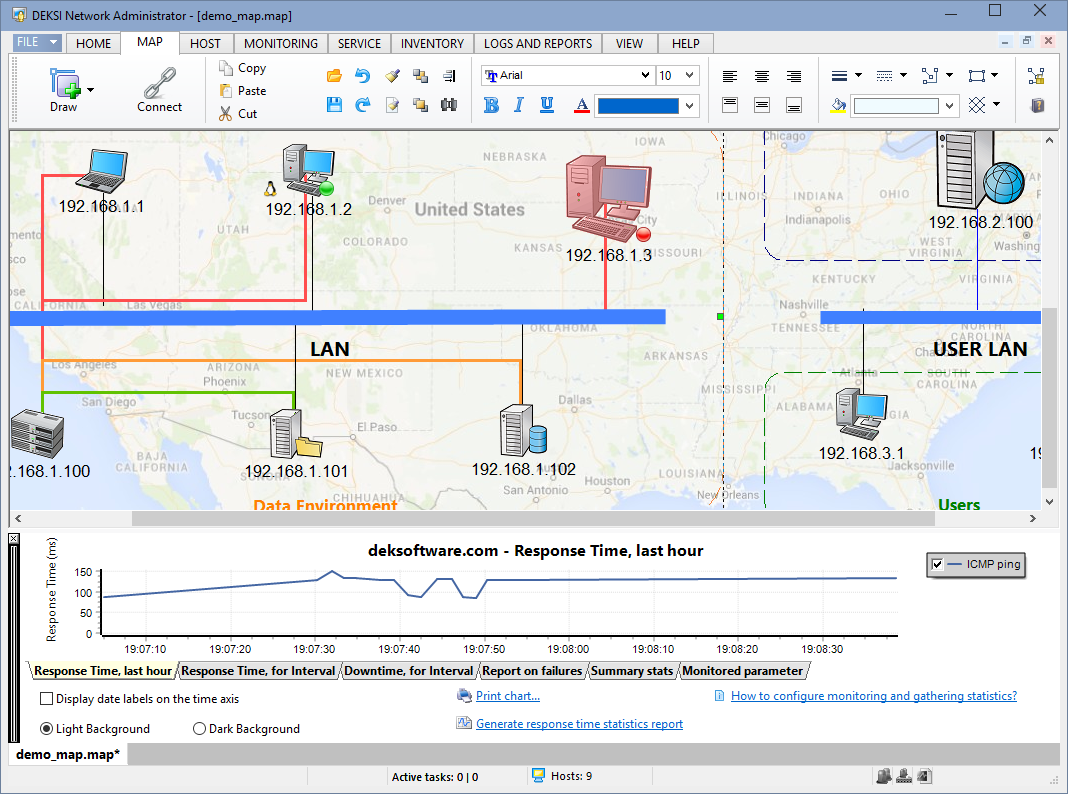
A simple mac GUI program is
https://www.macupdate.com/app/mac/28072/entonnoir/ which can limit the speed
Network Tool For Mac To Monitor Network Bandwidth Monitor
You can use dummynet ofcourse, There is extension of dummynet called KauNet. which can provide even more precise control of network conditions. It can drop/delay/re-order specific packets (that way you can perform more in-depth analysis of dropping key packets like TCP handshake to see how your web pages digest it). It also works in time domain. Usually most the emulators are tuned to work in data domain. In time domain you can specify from what time to what time you can alter the network conditions.
om-nom-nomIn case you need to simulate network connection quality when developing for Windows Phone, you might give a try to a Visual Studio built-in tool called Simulation Dashboard (more details here http://msdn.microsoft.com/en-us/library/windowsphone/develop/jj206952(v=vs.105).aspx):
You can use the Simulation Dashboard in Visual Studio to test your app for these connection problems, and to help prevent users from encountering scenarios like the following:
- High-resolution music or videos stutter or freeze while streaming, or take a long time to download over a low-bandwidth connection.
- Calls to a web service fail with a timeout.
- The app crashes when no network is available.
- Data transfer does not resume when the network connection is lost and then restored.
- The user’s battery is drained by a streaming app that uses the network inefficiently.
- Mapping the user’s route is interrupted in a navigation app.
...
In Visual Studio, on the Tools menu, open Simulation Dashboard. Find the network simulation section of the dashboard and check the Enable Network Simulation check box.
Network Tool For Mac To Monitor Network Bandwidth
Nikita G.Nikita G.Not the answer you're looking for? Browse other questions tagged networkingperformancesimulate or ask your own question.
How much bandwidth and data are the devices on your network using? Bandwidth hogs can slow down your entire network, and per-device data usage is important if your Internet service provider imposes a bandwidth cap.
Unfortunately, it’s tough to get a complete picture of your bandwidth and data usage on a normal home network. Your best best is a custom router firmware — but there are options even if you don’t want to use one of those.
Monitor Bandwidth and Data Usage on Your Router
RELATED:How to Use a Custom Firmware on Your Router and Why You Might Want To
The most accurate way to monitor this would be on your router itself. All the devices on your network connect to the Internet through your router, so this is the single point where bandwidth usage and data transfers can be monitored and logged.
This isn’t as easy as it should be. Most home routers don’t even include the ability to see which devices are using which amount of bandwidth at the moment, much less a history of how much data they’ve downloaded and uploaded this month. Some higher-end routers do offer the ability to keep track of how much data you’ve uploaded and downloaded each month, but they don’t necessarily offer per-device bandwidth status-viewing or a per-device data usage history.
Instead, you’ll need to depend on third-party router firmwares for this. Router firmwares like DD-WRT offer the ability to see live bandwidth usage, and you can check which devices are currently using the most data. This will let you pinpoint any devices hogging bandwidth at that very moment.
Monitoring data usage over an extended period of time is harder. The My Page add-on for DD-WRT does this well, although it will require additional storage on your router to continue logging all this data over time — a device plugged into USB storage, for example.
Getting a DD-WRT router so you can use this feature isn’t as hard as it might sound. For example, Buffalo offers routers that come with DD-WRT preinstalled, while Asus touts DD-WRT compatibility for their line of routers.
There’s also Gargoyle, an OpenWRT-based router firmware designed specifically for bandwidth and data usage monitoring. It can also enforce quotas on specific devices to prevent them from downloading and uploading too much data.
There’s a wrtbwmon script designed for routers running Linux-based firmwares like DD-WRT, OpenWRT, and Tomato. However, this script writes this information to a database which means you need to provide a separate database it can connect to over the network to log this information — it can’t do all the work on the router itself. It’s no longer under active development, but the author recommends a few forks of the Tomato router firmware that include features based on it. OpenWRT users can use luci-wrtbwmon, which makes things a little simpler.
Monitor on the Individual Devices
There’s no magic way to run a tool that somehow monitors all the traffic on your network without your router’s help. This information must be captured on your router itself. If you can’t actually capture or view this information on your router, you’re left relying on bandwidth-monitoring tools built into each device itself.
This is more complicated than it seems, too. You can’t just use a single method, as you could have Windows PCs, Macs, Android phones, iPhones and iPads, game consoles, smart TVs, and set-top streaming boxes all connected to your home router. Worse yet, many of these devices — laptops, smartphones, and tablets — won’t only use data on your home network. So you can’t even rely on a data usage meter that shows how much data you’ve downloaded on your laptop, as some of that will have taken place outside of your home on a different Wi-Fi network.
Different operating systems do have different tools that can help. GlassWire is a free and polished network-monitoring tool that will track data usage on all versions of Windows. On Windows 10 and 8, you could also set a specific connection as a “metered” connection and Windows will track data usage for it. This will change how Windows and some applications use the connection, however.
Macs can use Bandwidth+ from the Mac App Store. If the majority of your bandwidth usage takes place on a few computers, this will give you a decent overview of which ones are using the most data.
Android’s built-in data-usage monitor may allow you to monitor your Wi-Fi data usage, but not for a specific network — just all Wi-FI data. iPhones and iPads only allow you to monitor cellular data usage. You’ll need third-party apps for these devices to keep track of how much data you’re using on Wi-Fi.
The only way to get a complete picture is to monitor the data usage from your router. If you can’t do that but want to get some idea of which devices are using the most data, installing some of the above tools on your computers will help. But some devices won’t allow you to install apps that can help monitor this — game consoles and other devices that stream media from the Internet to your TV, for example.
If this is really important to you, your only real option is setting up a router with a custom router firmware and using a bandwidth-monitoring and data-usage-logging tool on it.
Image Credit: Timo Kuusela on Flickr
READ NEXT- › What Can I Do with My Old iPhone?
- › How to Stream UFC 242 Khabib vs. Poirier Live Online
- › Free Download: Microsoft’s PowerToys for Windows 10
- › How to Overclock Your Computer’s RAM
- › What’s New in Chrome 77, Arriving September 10