Ispect Tool For Mac
- How To Inspect On Computer
- Inspect Tool Download
- Inspect Tool For Mac
- Mac Tools For Sale
- Mac Inspect Element
- Mac Inspect Element Command
Google Chrome is not only a fast consumer browser – it also hides a host of developer features under its hood. You can reveal some of this power with the “Inspect” tool. While initially overwhelming, the tool grants you insight into how websites are constructed, and it can help you debug your own sites.
Accessing the Inspect Tool
The Inspect tool can be found in Chrome’s context menu.
Hey guys if i help you how to get inspect element please give this video a thumbs up and please like, subscribe and share (. It offers fewer options than its Windows counterparts, but this freeware system analysis and monitoring tool combines them all in one tidy package.
Right click on any element in your browser and click on “Inspect” in the context menu.
Front-end developers use the Inspect Element tool every day to modify the appearance of a web page and experiment with new ideas—and you can, too. Inspect Elements lets you tweak the appearance and content of a web page, by adding temporary edits to the site's CSS and HTML files. 'Inspect Element' is the tool we will explore most in this tutorial, and it's what opens first when you launch the Developer Tools in most browsers. Or, click the ' Elements ' tab in the Developer Tools to get back to it if you've been exploring elsewhere. Inspect and edit on the fly any element in the DOM tree in the Elements panel. View and change the CSS rules applied to any selected element in the Styles pane. View and edit a selected element's box model in the Computed pane. View any changes made to your page locally in the Sources panel. Word 2016 for Mac Help. Word 2016 for Mac More. Looking for something that’s not listed here? Use the Search box in the upper right corner of this window. Word Essentials. What's new and improved in Office 2016 for Mac. Word 2016 for Mac Quick Start Guide. 3 Free Apps to Analyze & Inspect Your Mac’s Hard Disk Space. Tim Brookes January 16, 2017 6 minutes. 3 Free Apps to Analyze & Inspect Your Mac’s Hard Disk Space. The Storage Management tool can also be accessed like any other app using Spotlight, or under the Applications > Utilities folder.
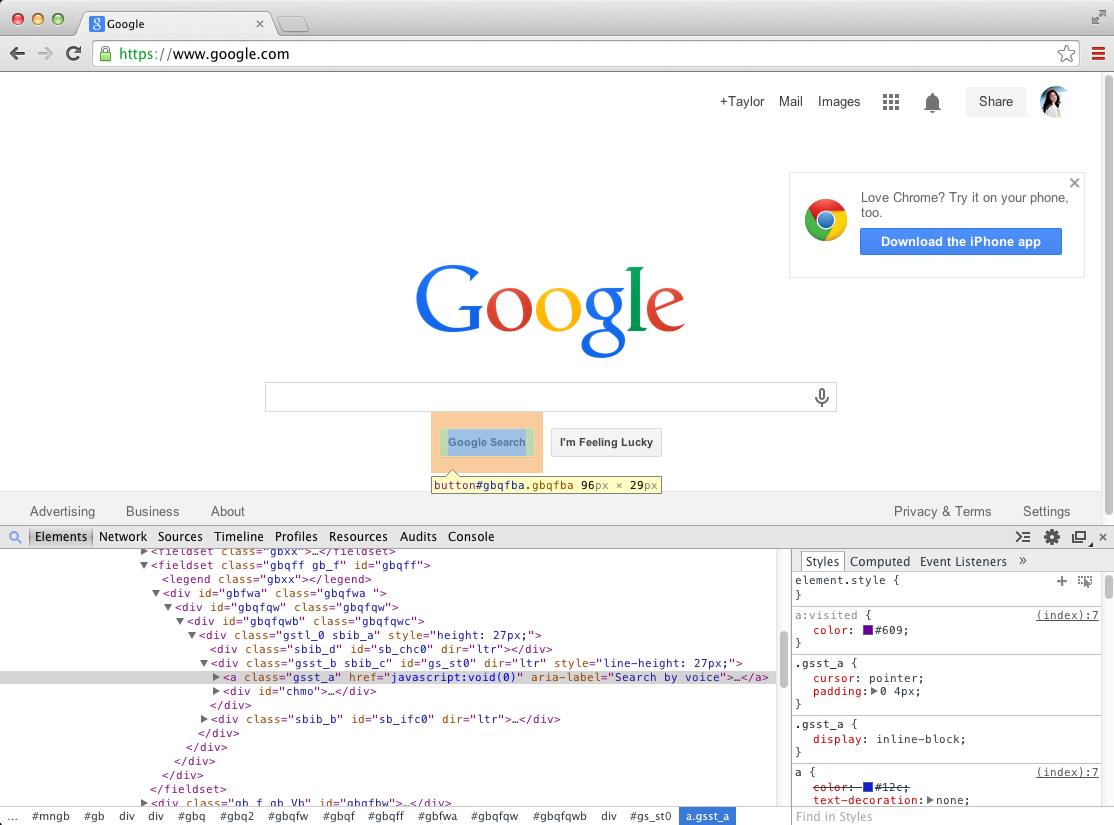
A window will pop out of the side of the Chrome browser as seen below. This is called the DevTools panel. If you’ve ever used Firebug on Firefox, you might recognize some parts of it.
How To Inspect On Computer
There’s a lot here, so let’s examine the individual pieces.
Inspecting the Inspector
The inspect panel is divided into several different tabs which are visible at the top of the window. We’ll focus on the default Elements tab.
There are two useful buttons next to these tabs. The first is the Inspect Element tool.
This tool allows you to mouse over and select different DOM elements to inspect.
The second button turns on Device Preview mode. In this mode you can see what your webpage looks like at different resolutions and screen sizes.
If you click on that button, you’ll see your webpage snap into a new view.
You can then use the drop-down menu above the page preview or the handles on the sides of the page preview to resize the device preview window.
HTML View
Most of the DevTools tab is occupied by the HTML pane.
This pane is like a super-powered “View Source.” It’s structured according to the DOM, with elements nested inside their parent elements.
You’ll see that the element you “inspected” at the beginning is automatically highlighted with a grey or blue background. Here, I’ve inspected an image which is contained in a link. As expected, I see a highlighted anchor tag.
But where’s my image? I can reveal any DOM elements nested in the anchor tag by clicking the disclosure triangle next to the <a>. In this case the arrow reveals the <img> tag I expected to find.
You’ll also notice a small menu bar at the bottom of the HTML pane.
This is called the breadcrumb trail, and it shows you all the parent elements of the selected element. To navigate to one of those elements, simply click it.
Styles
Underneath the HTML view we also see a pane that shows any CSS rules that apply to our element. This is called the Styles pane, and in this case we see all the rules that apply to the anchor tag I inspected earlier.
You can toggle a rule on and off by hovering over it and clicking the check box next to it.
You’ll see this change reflected in the page preview immediately. And if you click directly on a rule, you can change its name and value.
You can also search for particular rules using the Filter search box.
The Styles pane is capable of much more than just that, however. Check out Google’s documentation for a full explanation of the Style pane’s many functions.
Box Model and Computed Style
Next to the style view is the box model for my selected element. If you’re not familiar, the box model is an abstracted depiction of the margin, border, padding, and content size applied to a particular element.
In this case I can see my element has a primary size of 461 x 209 pixels. It contains no margin, border, or padding rules, so those boxes are blank.
If you do choose an element with some position, margin, border, or padding rules, your box model might look more like this.
You can also see an in situ box model if you mouse over DOM elements with the Inspect Element tool enabled.
Below the box model is a list of all the styling rules that apply to this particular element. This is slightly different form the Styles pane. It doesn’t display the actual lines of CSS – only the effects of those rules. This is called the “computed style” of the object, and it’s the combined result of your CSS.
Finally, you can search for particular rules by typing in the Filter box.
Conclusion
If you work with web pages frequently, Chrome’s Inspect tool is well worth exploring. And the other tabs in DevTools, like Console and Network, can be invaluable for developers. There’s more to that than we can cover right now, but Google’s own documentation is thorough and useful.
-->
Visual Studio for Mac Tools for Unity is a free Visual Studio extension that turns Visual Studio for Mac into a powerful tool for developing cross-platform games and apps with the Unity platform.
Unity integration is included out of the box in Visual Studio for Mac, and starting from Unity 2018.1, Visual Studio for Mac is the default C# IDE for Unity projects.
Note
This information is for Visual Studio for Mac IDE. For Visual Studio Code, see this guide for more information.
Overview
Here are some of the key features of Visual Studio for Mac Tools for Unity:
Compatible with Visual Studio for Mac Community Edition
Inspect Tool Download
Visual Studio for Mac Community Edition is available for free, and bundled with Unity installs starting with Unity 2018.1. See the Visual Studio for Mac Tools for Unity setup documentation for more information.
IntelliSense for Unity messages
IntelliSense makes it fast and easy to implement Unity messages like OnCollisionEnter, including their parameters.
Inspect Tool For Mac
Superior debugging
Visual Studio for Mac Tools for Unity supports all the debugging features that you expect from Visual Studio:
- Set breakpoints, including conditional breakpoints.
- Evaluate complex expressions in the Watch window.
- Inspect and modify the value of variables and arguments.
- Drill down into complex objects and data structures.
Powerful refactoring and context actions
Mac Tools For Sale
Write more usable code with quick menus and keyboard shortcuts for renaming, refactoring, and context actions.
Browse and add new files
Mac Inspect Element
Browse Unity projects and add folders, scripts, or shaders, all within the Visual Studio for Mac IDE.
Use familiar key bindings
Boost productivity by using the key bindings that you know. Visual Studio for Mac provides familiar key bindings for many popular IDEs, such as Visual Studio on Windows, ReSharper, Visual Studio Code, and Xcode.
Customize the Visual theme
Give your eyes a rest with the included dark theme.
Tips for Unity developers getting started with Visual Studio for Mac
Mac Inspect Element Command
These links explain useful features for Unity developers just starting with Visual Studio for Mac:
- Customizing the IDE – Learn how to change the visual theme or switch to a more familiar key binding scheme.
- Source Editor – Learn how Visual Studio for Mac can make writing better code faster and easier, including common keyboard shortcuts.