External Hard Drive Format Tool For Mac
Why to format hard drive on MacBook Air/Pro/iMac. There may be occasions when you need to format Mac hard drive. For example, you plan to backup DVDs to Mac hard drive or store other files and need to format an external hard drive for macOS to extend storage space. Format external drives to Mac OS Extended before using with Aperture Tips on preparing a new external hard drive for use with Aperture. You may wish to use an external FireWire or USB hard drive to store your Aperture Library, referenced images, or Vaults. If you read my previous post about how to format an external hard drive, you know that I bought a 2TB Seagate Expansion external drive (see it on Amazon) and managed to create two partitions on the disk — one for Mac backup purposes, and the other for personal use.
- How To Format A External Hard Drive
- External Hard Drive Format For Mac And Pc
- Format External Drive For Mac
- Best Format For External Hard Drive
If you need to format external hard drive Mac or Windows, you may also consider the exFAT files system. Developed by Microsoft, this modern file system is optimized for situations where the NTFS file system is not a feasible solution, and the file size limit of the standard FAT32 file system is unacceptable.
Pretty much all functions that modern computer devices can perform are either easy to understand and access or are done by the device automatically. Most, but not all, formatting drives being one that you have to do manually, Mac computers included.
A lot of people would gladly avoid such chores entirely instead of having to look up every term and action, many of these people being Mac users, who use Apple’s operating system for that exact reason – you don’t need as much tech knowledge as you do with managing a PC system. This is why we have compiled a short guide to formatting your hard drive and explaining what it means altogether.
What is formatting and why you need to do it?
How To Format A External Hard Drive
Formatting is a process used to “tell” the hard drive the correct orders and logic paths to work with a certain operating system to ensure that the data you want to put on the hard drive will be accessible and recognizable by said OS. The reasoning behind this is that different operating systems use different protocols to save information on drives, for example, a Mac won’t recognize a hard drive that has been formatted for Windows usage and vice versa. In short, you need formatting to prepare the drive for working with a Mac system.
Note that formatting a drive or a partition of the drive (discussed further) will delete all data that the drive or partition holds, so make sure you don’t have any files that you might need on your external hard drive. In short, you need formatting to prepare the drive for working with a Mac system.
Partitions
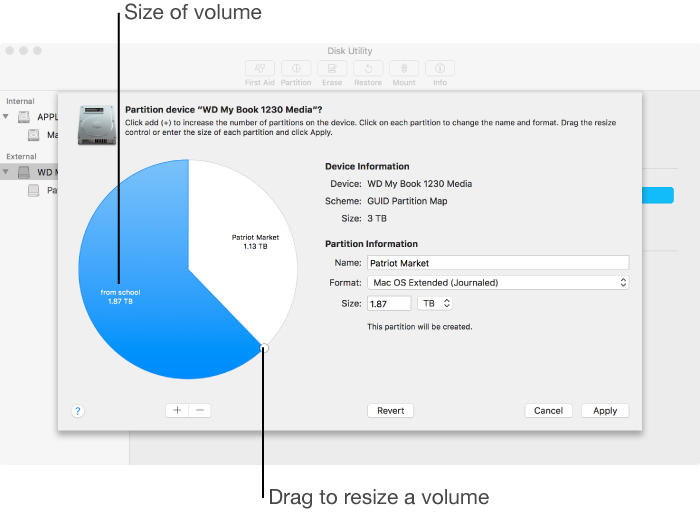
We mentioned partitions earlier, but what are they? A partition is, in Layman’s terms, a “section” of a hard drive, kind of like a chapter in a book, except different partitions on the same drive have nothing to do with each other. This separation is the whole point of having partitions on a drive since you can save a Mac OS on one partition, a Windows OS on another one and have a third one for files such as music and images, which allows you to use the drive with different systems.It’s basically like splitting the drive into different pieces for different uses, just have those parts contained in one handy device.
It’s basically like splitting the drive into different pieces for different uses, just have those parts contained in one handy device.
Format External Hard Drive – Mac
The default tool for formatting hard drives for a Mac is Disk Utility, which can be opened by typing “Disk Utility” in the Spotlight search bar in the top-right corner of your desktop or by locating it under Applications/Utility.
After you’ve opened the utility from the search list, you should see a window with a list of storage devices on the left. Choose your external hard drive on this list which will let you perform different actions with it (do NOT accidentally format the main internal drive).
To format your drive, press Erase (as discussed before, formatting clears your drive of all data to prepare it for work), which will open a smaller window. In this window, you can enter the name of the drive (how it will show up on your desktop), choose the format and scheme.
The scheme, which is the method by which the hard drive determines its partitions etc., should be set to GUID Partition Map:
- GUID Partition Map is what the industry is moving toward in regards to compatibility.
- Master Boot Record scheme is used for compatibility with other PCs but is slowly being replaced by GUID
- Apple Partition Map is used by Mac computers that are closer to relic than useful computers nowadays.
For format external hard drive (Mac), which determines how any future files on the drive or partition will be treated, you should probably go for OSX Extended (Journaled):
- OSX Extended (Journaled) will encrypt all data on the drive, making it more secure and accessible only via a password.
- MAC OS Extended(Case-Sensitive, Journaled) is used to save multiple files with the same name, for example, Pic.jpg and pic.jpg would be two different files (a very niche option).
- MS-DOS FAT will be optimum for a drive that would be used with PCs and Macs alike since this format is the most compatible.
- ExFAT is also a very compatible option, however, this one is fit more for flash drives.
After naming your drive and picking the format and scheme, press the “Erase” button and the formatting process will start. When the formatting process finishes, your drive should show up on your desktop, but if it doesn’t, go to Finder/Preferences and make sure that external drives are marked to be shown on your desktop. After this, you should be good to go!
Related articles:
- The Best External Hard Drives
- The Best External Hard Drives for Mac
- How to Format External Hard Drive for Mac and PC?
- How to test a Hard Drive for Problems?
- Eye Care for Computer Users
Macs format drives with Apple’s HFS+ file system, which Windows won’t recognize or access without third-party software. Macs may also create a protected EFI partition on these drives that you can’t delete with the usual disk-partitioning tools.
External Hard Drive Format For Mac And Pc
Some drives are even sold as “Mac-formatted drives” — this just means they come with the Mac HFS+ file system instead of NTFS or FAT32. Macs can read NTFS drives, and can read and write to FAT32 drives.
Back Up the Drive’s Data First
First, back up the data on the Mac-formatted drive if you have anything important on it. This process won’t actually convert the file system. Instead, we’ll just be wiping the drive and starting over from scratch. Any files on the drive will be erased.
If you have a Mac lying around, you can plug the drive into a Mac and back up the files. If you only have Windows systems available, you can use HFSExplorer to copy files from the drive onto your Windows system drive or another drive. HFSExplorer unfortunately requires you install Java to use it, but it’s the only free option here. You’ll probably want to uninstall Java when you’re done.
Erase the Mac Partitions, Including the EFI System Partition
RELATED:Understanding Hard Drive Partitioning with Disk Management
First, open the Windows Disk Management tool. Press Windows Key + R to open the Run dialog, type diskmgmt.msc into the box, and press Enter to open it. This tool allows you to manage the partitions on drives connected to your computer — internal ones or external ones connected via USB.
Locate the Mac drive in the list of disks. Be sure you’ve identified the Mac drive — if you accidentally delete partitions from another drive, you could damage your Windows installation or lose your files.
If you’re lucky, you can just right-click each partition on the Mac drive and select Delete Volume to remove the partitions. You can then right-click in the empty space and select New Simple Volume to create a partition and format it with the Windows NTFS or FAT32 file systems.
The Mac drive may have an “EFI System Partition” on it. This partition is marked as protected, so you can’t just right-click and delete it — the delete option will be disabled.
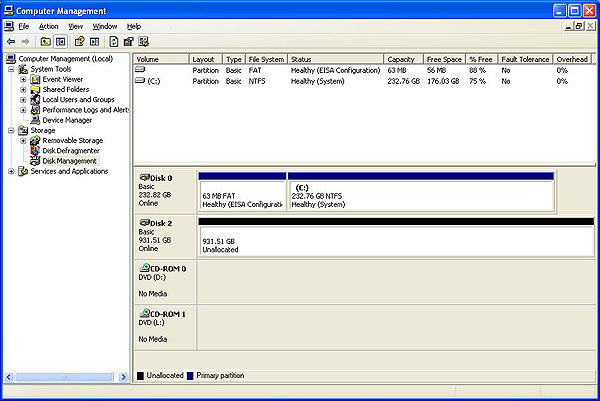
To erase this partition, we’ll have to wipe the entire disk. This process erases everything on the disk, including its files and all its partitions. First, note the number of the disk in the disk management window. For example, in the screenshot below, the Mac-formatted drive is Disk 2.
Next, open a Command Prompt window as administrator. To do this on Windows 8 or Windows 7, press the Windows key once, type cmd , and press Ctrl+Shift+Enter.
Type diskpart into the Command Prompt window and press Enter.
Type list disk at the DISKPART prompt and press Enter to view a list of disks connected to your computer. Identify the number of your Mac disk in the list. It should be the same as the number of the disk in the Disk Management window.
Be sure to double-check this — you could accidentally wipe the wrong drive if you select the wrong disk here.
Type select disk # and press Enter to select the Mac disk, replacing # with the number of the Mac disk. For example, here we’d type select disk 2.
Finally, type clean and press Enter. This command erases the entire selected disk, including all its files and partitions — whether they’re protected or not. You’ll have an empty, uninitialized disk after you do this.
Close the Command Prompt window when you see a message saying “DiskPart succeeded in cleaning the disk.”
Create an NTFS or FAT32 Partition
You can now open the Disk Management window again. If you’ve left it open, you may have to click Action > Rescan Disks to update the data.
Locate the Mac disk in the list. It will be completely empty and display a message saying “Not Initialized.” Right-click it and select Initialize Disk.
Select the MBR or GPT partition table format and click OK to create a partition table for the disk.
Format External Drive For Mac
Right-click in the unallocated space on the initialized disk and select New Simple Volume. Use the wizard to create a partition with the NTFS or FAT32 file system. The drive will now be formatted for use by Windows systems. There will be no space wasted by protected Mac partitions.
Some Mac functions require an HFS+ formatted drive. For example, Time Machine can only back up to HFS+ formatted drives.
Image Credit: Konstantinos Payavlas on Flickr
READ NEXTBest Format For External Hard Drive
- › What Can I Do with My Old iPhone?
- › How to Stream UFC 242 Khabib vs. Poirier Live Online
- › Free Download: Microsoft’s PowerToys for Windows 10
- › How to Overclock Your Computer’s RAM
- › What’s New in Chrome 77, Arriving September 10