Best Project Management Tool For Mac
Things is a polished to-do and project management tool exclusive to Mac OS X and iOS. The interface is easy to navigate, keyboard shortcuts are abundant, and it's extremely well integrated into. The Best Project Management Software for Mac Googling Mac-specific project management software largely leads to lots of cloud-based options. While programs like Wrike, LiquidPlanner, and Teamwork are fantastic tools for Mac, many companies are looking for a locally installed option. Things is a polished to-do and project management tool exclusive to Mac OS X and iOS. The interface is easy to navigate, keyboard shortcuts are abundant, and it's extremely well integrated into. The best project management software accommodates every kind of project, from ongoing day-to-day work to big-picture initiatives. We looked for the software that can help any project thrive, with a wealth of reporting and scheduling features and an intuitive design. Bottom Line Genius Project is an enterprise project management solution that offers a variety of features that can be used for the effective management of projects, scaling from smaller task-based.
Best Communication Tool | Best for Visual Thinkers |
How We Found the Best Project Management Software Programs
6 experts interviewed
The Best Project Management Software Programs
The best project management software accommodates every kind of project, from ongoing day-to-day work to big-picture initiatives. We looked for the software that can help any project thrive, with a wealth of reporting and scheduling features and an intuitive design. We spent a week testing 10 of the most popular options and found five top picks that can work with any team.
The 5 Best Project Management Software Programs
- Asana -
Best Task Management Tool
- Basecamp -
Best Communication Tool
- monday.com -
Best for Beginners
- Casual -
Best for Visual Thinkers
- Trello -
Best Free Project Management Software
Asana
Simple task management
Comprehensive reporting tools
Third-party integrations
Intuitive mobile app
Why we chose it
Simple task management
For a project management software’s most essential function — keeping your team on track and in step through every phase of a project — Asana did the best job of any product we tested. We appreciated how it balanced an individual’s workload with the bigger picture of the entire team. Your personal deadlines and tasks are always in view, but it’s also just as easy for managers to track the entire team’s progress with features like automated progress charts and team-wide task calendars. The way Asana breaks down huge projects into manageable and easy-to-follow pieces makes it the most intuitive task management system of the bunch.
Comprehensive reporting tools
Asana also has a number of tools that make it simple for managers to capture a bird’s-eye view of their team’s progress. One of the ones we liked the most was the ability to automatically export a project’s data into Google Sheets. Once there, the spreadsheet is already organized into practical sections like the number of overdue, completed, or in-progress tasks for all of your projects. Your report comes pre-loaded with two tools depending on what’s in your Dashboard — ours had two graphs showing the number of overdue, assigned, and incomplete tasks by project — but we found it simple to tailor to our specific needs.
Third-party integrations
One of the biggest talking points in reviews of Asana is how seamlessly it fits with other programs. We saw that clearly in our testing: Asana has the best collection of third-party integrations of any software out there. You can set up notifications or create new tasks in messaging apps like Slack and Hipchat, attach files from storage programs like Google Drive and OneDrive, and automatically create Asana tasks in development services like Jira and GitHub. It was the only software in our tests that offered integrations with all six of those popular apps. We also loved the Chrome extension, which allows you to create a task from any page with only a couple of clicks.
Intuitive mobile app
If you want to double-check your calendar or the status of your tasks while you’re away from your computer, a functional mobile app can eliminate a lot of headaches. Asana’s is one of the most well-received in the industry, earning a 4.8 rating on over 2,000 reviews in the App Store and a 4.3 on over 20,000 reviews in Google Play. That’s just about even with Basecamp and Trello, and well above monday.com and Casual.
It’s easy to see why. Asana’s interface translates incredibly well to a mobile screen; all of your tasks, messages, and projects are accessible with one click from anywhere in the app, so you never have to spend much time probing around. You won’t want to use it for everything — exporting data would be pretty cumbersome, for example — but it’s nice to have around for more basic functions.
Points to consider
Steeper learning curve
Because of Asana’s considerable project management capabilities, it can take a little more time to learn than other software, especially if your team is used to something more limited. It’s unclear at first how you should be using your Dashboard, for example: You must add projects in order to take advantage of its functions, meaning you’re initially presented with a blank screen.
Still, even if tools like these aren’t totally intuitive when you first start using Asana, the crucial aspects for most team members — task and calendar management — are front and center. Asana also has an enormous library of resources and tutorials for using the software, so most issues can be addressed without too much trouble.
It wasn’t immediately clear to our tester how to take advantage of tools like Asana’s Dashboard.
No direct messaging
While having a conversation with your entire team in Asana is incredibly simple, we couldn’t find any easy way to directly message our team members, something that was pretty standard on other software we tested. While there is a workaround — you can create a private project for messaging and invite each individual into separate conversations within the project — it’s enough of a hassle that most people will probably just stick with Slack or email.
Basecamp
Great for group discussions
Flat monthly price
Stellar apps
Sub-par task management
Lacks reporting tools
Why we chose it
Great for group discussions
Basecamp’s biggest draw is that it’s a one-stop shop for all of your team’s communications, eliminating lengthy email threads. It functions like a message board — you can post a topic to your team’s page, and everyone with access can add to the conversation for as long as they want. You can also set up recurring prompts each week or month to spur conversations within your team. Questions like “What was a successful project you worked on this month?” might be cumbersome or awkward to to send in an email or Slack, but they work perfectly with Basecamp’s format. We also loved the ability to add email notifications to important topics, so team members won’t miss out on anything.
Flat monthly price
Basecamp has one of the simplest pricing structures of any project management software on the market at $99 per month, no strings attached. Granted, that’s a lot for smaller teams, but for anyone with more than a dozen users, Basecamp is an absolute steal. You can have as many users as you want, and you don’t have to commit to anything longer than a month.
Stellar apps
Because Basecamp excels as a communication tool, we appreciated that it has dedicated apps for any kind of device. Instead of getting an email for every new message (or being forced to check a browser periodically), you can set up Basecamp notifications on your phone or desktop for exactly what you need to know about — for instance, if you’re mentioned in a conversation or if a thread you’re following has a new comment.
We found both the desktop and mobile apps to be well-designed and intuitive, which was backed up by user reviews. Both apps are unanimously well-received, earning a 4.7 rating on over 15,000 reviews in the App Store and a 4.4 on over 2,500 reviews in Google Play. Along with Asana and Trello, that was the loudest endorsement we heard for any project management software out there.
Points to consider
Sub-par task management
It’s hard to imagine using Basecamp as your team’s primary task management system. Each user has a list of assignments, but they’re little more than a to-do list. We found it difficult to track all of the moving parts of a project at once, let alone several overlapping ones. When you open the calendar, you can’t see at a glance what everyone is working on and how much progress is being made on each project; it just shows you how many tasks are due each day. This works fine as a basic to-do list for your team, but we found it to be one of the more limited task management interfaces.
Lacks reporting tools
Basecamp also doesn’t include any tools to help you visualize what’s going on with your team. Unlike Asana, which automatically turns calendar and task data into useful visuals, Basecamp leaves that work to you. If you’re looking for advanced project management tools beyond team communication, you’ll be better suited to one of our other picks.
monday.com
Personalized design
Customizable templates
Shareable with outside clients
Why we chose it
Personalized design
Out of all of the project management programs we tested, monday.com was the one that allowed us to really hit the ground running. Everything about this software is intuitive. The sidebar menu is divided into “Talks” and “Boards.” Within these, you can track ongoing “pulses”: specific tasks, entire projects, or even potential clients. We like how monday.com doesn’t force you into any one approach for tracking your tasks and projects; however you would naturally think about your work, it accommodates you.
Customizable templates
If you do need a little help getting started (or just don’t want to manually input all relevant labels for your projects), monday.com comes pre-loaded with 44 different templates, broken up into sectors like marketing, HR, and software development. This structured approach makes the setup process a little less painful, especially for people who aren’t used to working with project management software.
Once you do get used to the platform, there are still options to customize according to your team’s needs. Want to break down “task date” into a start date and a due date in the Team Tasks template? Just click the plus sign next to the task and choose “Date” for the new column type. No matter how we wanted to customize the template, it never took more than a few clicks to achieve.
Shareable with outside clients
If you want to keep people outside of your organization up to date on specific projects and timelines, monday.com was the only software in our tests that provided a “shareable boards” feature. This is especially useful for clients who want to monitor the status of their project, or for freelancers who would benefit from seeing an individual project’s calendar without necessarily needing access to the team’s entire workload.
Points to consider
Limited tools
The same thing that makes monday.com a great place for beginners might make it feel limiting for more detail-oriented users. Part of the reason it’s so easy to use is that it doesn’t have as extensive a collection of features and tools as software like Asana. Instead, it focuses on organizing your tasks and projects in the most intuitive way possible — something it does really well. It won’t automatically visualize data for you, it doesn’t have many financial management tools, and project managers raised on Gantt charts might miss that tool (although monday.com makes a pretty compelling case on its blog for abandoning them).
Expensive for small teams
If your team only consists of a few people, monday.com probably isn’t worth the price of admission. While most companies charge per user, monday.com uses eight different tiers of pricing depending on your company size. The smallest one is for five users at $39 per month for the Standard plan. For comparison, Asana costs $6.25 per user for teams with fewer than 15 users. For three-person teams, that’s about half the price of monday.com.
Casual
Visual project maps
Storage compatibility
Affordable pricing for small teams
Lacks tools for bigger teams
Subpar mobile app
Why we chose it
Visual project maps
Casual has one of the most visually pleasing and intuitive interfaces of any project management software we saw. It works like a mindmap: The main page is an infinite grid that you can populate with tasks and arrange in whatever manner makes sense for your project. Within those tasks, you can assign multiple team members and a due date, plus upload any relevant files. And if a task requires multiple smaller steps to complete, you can convert it to a group, which creates a mini-project inside the task. We’ll be honest, most project management programs feel like work. Casual was the only one we tested that was actually fun to mess around with, taking us back to afternoons in computer class doodling in MS Paint.
Storage compatibility
For a smaller and more affordable project management system, Casual has storage integrations that rival much bigger names. You can import files from every conceivable cloud-based service: Google Drive, Microsoft OneDrive, Dropbox, and Box are all built right into the system, allowing you to attach relevant documents, spreadsheets, or images to any task or project. Of our five top picks, Asana was the only other program to include integrations with these four main storage services.
Affordable pricing for small teams
Casual has one of the friendliest pricing structures for smaller teams that we saw. Companies usually charge one of two ways: per user (usually around $10 per month, with prices decreasing for more users) or a flat rate every month (anywhere from $45 to $99 per month). With both of these options, teams with only a few people end up paying more. Casual charges $7 for up to two users and $21 for up to five, ensuring you’ll never pay more than $7 per user no matter what size your team is.
Points to consider
Lacks tools for bigger teams
Casual’s intuitive layout and small team pricing does come with some drawbacks: It doesn’t have nearly the same level of functionality as an all-around tool like Asana. It’s a fairly bare-bones task management system, focusing on helping you get your projects done on time and in the simplest way possible. We missed the ability to communicate with our team members within the program, which would get especially problematic if you have a larger team trying to navigate one project. It also doesn’t come with a ton of third-party integrations. While the essential storage options are all there, Casual lacks support for communication apps like Slack and development products like Jira.
Subpar mobile app
While it wasn’t the worst that we tried (that distinction would go to Aha!), Casual’s appealing layout doesn’t translate well to its mobile app. Instead of the limitless grid we loved so much on our desktop, the mobile app gives you a basic list of tasks. It’s also worth noting that you can’t create a new account through the app; you can only log into an existing one. This was a big reason for Casual’s mediocre three-star rating on Google Play.
Trello
Generous free version
Easy to learn
Highly rated desktop and mobile apps
No calendar view
10 MB file size limit
Limited integrations
*Price goes down for teams with 300+ users
Why we chose it
Generous free version
While a lot of free project management software limits you to a certain number of users, projects, and tasks, Trello's free version is completely unlimited in all of these areas. You can create as many boards as you need, assign tasks throughout your team, and take full advantage of Trello’s desktop and mobile app functionality. You also have access to the huge collection of templates and sample boards that are tailored to specific types of projects, a nice add-on that we didn’t see in any other free software.
Easy to learn
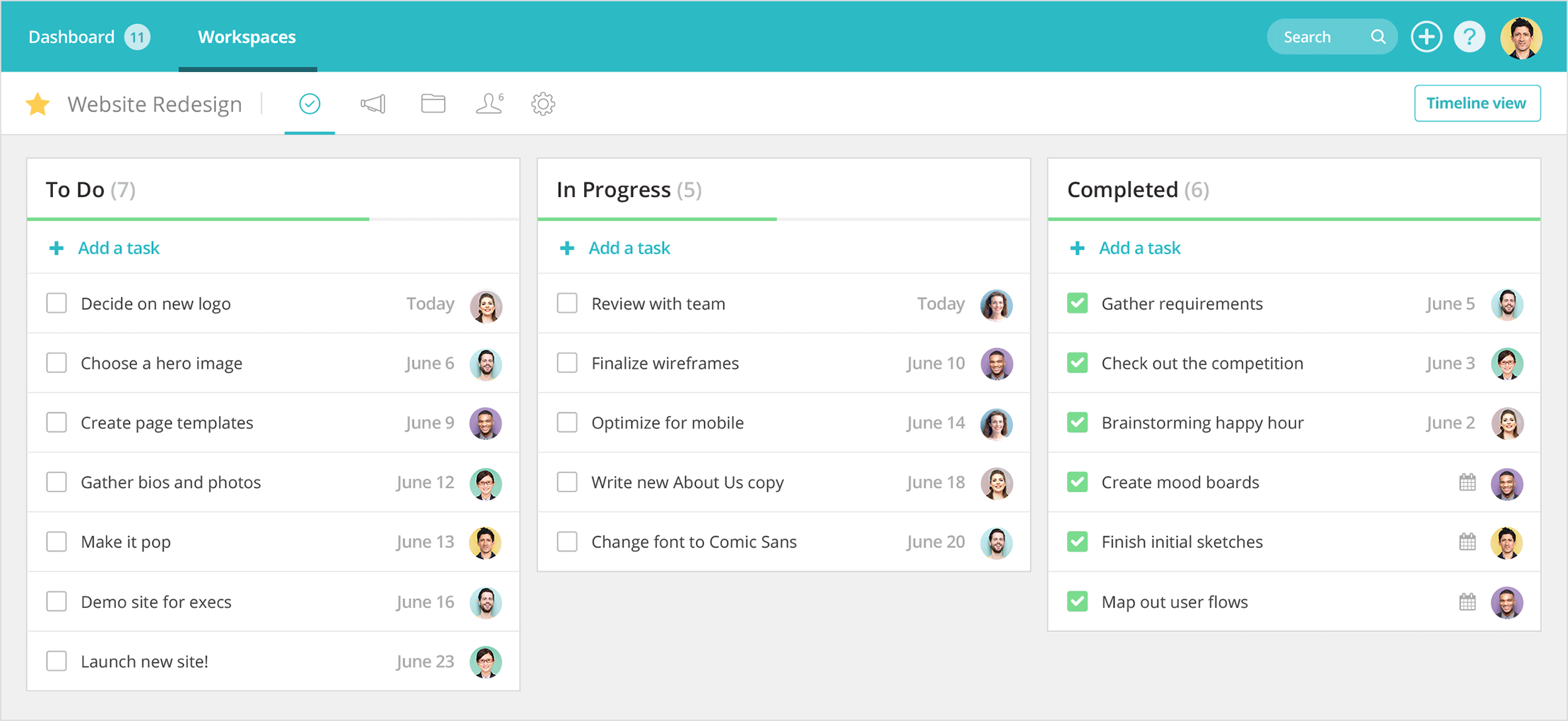
Trello has one of the simplest designs of any project management software that we tested. Like Asana, each project is its own board, with tasks divided into easily scannable phases; once a task is complete, you just drag it into the next phase on your board. It’s extremely intuitive and simple to customize. After a few minutes of playing around with it, we were just as comfortable setting up team projects for work as we were creating private boards for potential vacation spots.
Highly rated desktop and mobile apps
Along with Basecamp, Trello was one of the only project management programs we saw that has desktop apps for both Mac and PC in addition to mobile apps. They were also some of the most well-received, scoring a 4.7 on over 2,000 reviews in the App Store and a 4.5 on over 73,000 in Google Play. The desktop apps aren’t just glorified versions of the browser, either. You can customize your notifications for things like new comments on a task, when something is moved from one phase to another, or if someone uploads an attachment to a task you’re following. It's a nice middle ground for those of us who don’t necessarily need email notifications for everything but still want to stay up to date without constantly checking browsers.
Points to consider
No calendar view
The biggest obstacle to using Trello’s free software for most project managers is the lack of a calendar view. There’s no way to monitor your entire team’s workload automatically without this — managers have to manually track hours and tasks outside of the app. Calendar view is available through a “Power-Up,” but Trello only allows one of these in its free version.
10 MB file size limit
Another constraint Trello puts on its free version is a 10 MB size limit on files uploaded from your computer. When you upgrade to the cheapest paid plan, that size goes all the way up to 250 MB. 10 MB is roughly the size limit most email services use for their attachments, so if your team is already running into that issue, it might be worth upgrading to a paid plan or considering an alternate file sharing system.
Limited integrations
Trello only allows one third-party integration (which it calls a “Power-Up”) in its free version. This doesn’t apply to cloud storage services — Trello lets you attach files from Google Drive, Dropbox, Box, and OneDrive for free — but limits more specialized integrations with apps like Jira and Slack. These can be extremely helpful if your team is already relying on other software. If you want to get notifications in Slack when someone adds you to a task, for example, you would have to use a Power-Up. If you upgrade to the paid version of Trello, the number of Power-Ups you have access to is unlimited.
Guide to Project Management Software
How to get the most out of your project management software
Determine who will use the software
The size of your team tells you a lot about the software you need. A smaller team will want a simple system for organizing tasks and schedules, while a manager with dozens of employees will need a full roster of reporting tools and integrations.
Establish your team’s needs
“When you know what your business needs, you can draw up a shortlist of features that will help you narrow down the project management software products that will help your business take the next step,” project management expert Elizabeth Harrin advises. Poll your team and see what they’d like to get out of a new tool and where the current system is falling short.
Compare prices
Evaluate which products fit your budget. Team size also comes into play here: Companies usually charge either a flat monthly rate or a rate per user. In general, teams with more than 10 people will save by choosing a flat rate plan.
Best Free Project Management Tool For Mac
Pay annually
Aside from Basecamp, all of our top picks offer a hefty discount for committing to a full year rather than going month-to-month. A 20-person team using Asana’s Premium plan, for instance, would save $480 by paying for an entire year upfront. If you’ve tested out a few options and feel comfortable paying that initial lump-sum bill, you’ll see significant savings in the long run.
Test-drive a few options
Almost every software offers a 30-day free trial, and we recommend taking full advantage of it. Have your team schedule a project with each one and solicit their feedback on which they preferred, what kinds of problems they anticipate, and how it would impact their work. That way, when it comes time to fully rely on a new software, it won’t be completely unfamiliar.
Project Management Software FAQ
Project management software is a broad term for any program that’s dedicated to keeping projects on schedule, on budget, and on target. Most project management software includes features like time tracking, file sharing, communication, task management, and reporting tools.
In general, task management software is designed more for individuals than teams. Products marketed for task management usually don’t have much in the way of communication tools or file sharing, instead focusing on keeping a single person on schedule. These are usually available for free, as they don’t have the breadth of tools you’ll find in most project management software.
We recommend trying out three options. According to research from Capterra, those who demoed three products reported being the most satisfied with their choice. Fewer than that didn’t give them enough information, and more proved to be too much. Every software has a learning curve, and it’s easy to become overwhelmed if you test too many products. Setting clear standards on what features you need and what budget you’re working with will do a lot of the heavy lifting for you.
By the time you’re ready to test project management software, you’ve likely picked a few options that have all of the features and tools you’ll need. Here are some of the things you should look for in testing:
- An interface that’s intuitive to navigate and learn
- Responsive customer service that’s reachable by email, phone, or chat
- Functional mobile and desktop apps
- Integrations with other software that your team uses
The Best Project Management Software Programs: Summed Up
You might also like
The Best Air Purifier
October 25, 2016 | Home Appliances
The Best Homeowners Insurance Companies
September 22, 2015 | Homeowners Insurance
Statistics show that MacOS is just about 10 percent of the global computer operating systems market. However, the ability of the well-designed Mac computer models to operate web-based applications has now made it a familiar business work desktop for project management.
Web designers, creatives, and developers who are also Mac users see the value and benefits of using a project management tool, especially web-based apps. Online PM tools are usually cross-platform functional, so it works on different environment like MacOS, iOS, Windows, Android, etc. PM tools have two major benefits:
- It organizes their work, clients, resources, schedules, etc.
- It enables them to plan and breakdown projects into clear manageable tasks
The Top 10
Project professionals who prefer working on a Mac and looking for decent project management software can check the brief reviews below for the following PM tools. Most have core project management features, but a few also go beyond project planning and task management.
#1 Smartsheet
Smartsheet is a web-based project management and collaboration tool in a simple and familiar spreadsheet interface. It is easy to use and very flexible, but is also a business-grade application that has increased team productivity in tens of thousands of companies and organizations around the globe.
Smartsheet Software Features
- Multiple views: Team availability, timelines, Gantt chart, calendar, card view
- Automated tools: Alerts, email reminders, and web forms
- Familiar interface: Spreadsheet-like UI does not have steep learning curve
- Easy to start: Pre-built templates help jump-start different types of projects
Advantages of Smartsheet
- A familiar interface will not require time for employee training, but allows them to hit the ground running.
- SaaS pricing model is not capital intensive, and easy to scale when growing in company size.
- Online collaboration and integration makes it easy to communicate and partner with others.
- Free email support and priority phone support for enterprise customers.
- Free 30-day trial period.
#2 Wrike
Wrike is an online project management software that helps users manage their projects from initial request to reporting end results. It is an end-to-end solution, providing managers the ability to create and assign tasks, create workflows, visibly track progress, coordinate resources, and generate reports. Team members also get a clear view of priorities, access all tasks, documents and work information, edit, upload and share documents, and track time.
Wrike Software Features
- Task, Project and People Management: Create projects from tasks, assign resources from tasks, and receive instant and direct communication with collaboration tools such as @mentions.
- Email Integration, Custom Workflows: Users can work and participate from their email inbox, and sync all updates. They can add custom fields and configure dashboards for customized views.
- Native Mobile Apps, Third-party Integrations: Wrike has native iOS and Android apps for working away from office. It integrates with other apps to enable teams extend functionality and get all types of work done with multiple tools, including an API.
Advantages of Wrike
- Helps project teams quickly set priorities and align teams with tools like Gantt chart with critical path, workload views, and real-time status updates.
- Automated forms, proofing and approval help people across the organization to coordinate smoothly and reduce rework.
- User roles and share permissions ensure data integrity while reducing duplication and redundancy.
- Web-based application provides real-time visibility for all users just by accessing a central site. The centralized system also ensures clarity and accountability.
#3 Mavenlink
Mavenlink is a project management software built by a privately held California, USA company. It is also web-based, and works with popular browsers such as Safari. The software for teams start at $19 per month on an annual contract for the first 5 users.
Mavenlink Software Features
- Project Management and Accounting: Enables users to track not only tasks but also project fees, costs, and expenses.
- Interactive Gantt chart: The chart shows tasks, dependencies and critical path.
- Resource Management and Collaboration: Users can see a complete view of the business with project dashboards, reports, centralized conversations, and file management.
- Business Intelligence and Operations Expertise: Mavenlink provides pre-built and custom reports. MavenOps is a service offered to clients to take advantage of industry know-how and consultations.
Advantages of Mavenlink
- User-driven design makes it easy and painless for onboarding new team members.
- Integrations with Salesforce, Jira, Google Apps, Quickbooks, and others. It also has API for custom integration.
- Web-based application requires no download or installation, but provides automatic updates for the latest features.
- HTML5 technology enables different device access and compatibility.
- Supports different types of authentication from identity providers, such as secure SSO.
- A free plan is available also upon registration.
#4 Microsoft Project Online
MS Project was developed by Microsoft in 1984 and the tool has evolved over the last 3 decades. The latest version is Project 2016.
MS Project Software Features
Improved Interface: Navigation and use of the project management tool has been made easy.
Auto Complete: Filling up of repetitive data has become effortless.
Timeline View: Users can easily view the project schedule and progress in graphical form.
Filters: New filters can be applied for quick data mining.
Advantages of MS Project
- All sorts of charts and graphs have been included over the years.
- Reliable online support is available.
- No internet connection is required.
- Can be easily integrated with other MS programs.
- Caters to a wide range of project managers and is ideal for large organizations.
#5 Merlin
Merlin is one of the leading project management tools for Mac OS X. The software has been developed by Project Wizards and is renowned for its collaboration options. Merlin is divided into 4 products, namely, Project, Go, Server, and Project Express.
Merlin Software Features
Project management: Projects can be planned and managed to the very last detail. All projects are outlined in the form of a hierarchy, and each aspect of the project has its own place on the hierarchy. It is now also ready for agile project management with Kanban boards. The tool is priced at $149 per year. Merlin Project version 5 has been released. In fact, v5.0.3 is the latest version as of July 12, 2018. New features include grouping, new styles, and more.
Resource Management: All the workload assigned to each member of the team, along with all the allocated resources, are calculated and represented in the form of bar graphs. The new Resource Pool feature allows users to monitor the utilization level of projects.
Other features of Merlin include:
- Full 30 days free trial
- To do list, Kanban, Grouping, Resource pool
- Graphs, charts, New Style Editor
- Network friendliness, clean modern design
Advantages of Merlin
- Merlin Project can import and export project data, integrates with many applications, and also connect with other apps through AppleScript.
- Projects can be planned and managed to the very last detail.
- The software shows utilization of resources so that resource and work allocation becomes easy.
- Tutorials are available for each feature, and the features are easy to use for users of all levels.
- Project Wizard also offers workshops, for users to get familiar with all the features on Merlin.
#6 OmniPlan
Best Project Management Tool
OmniPlan is a popular project management application developed by The Omni Group. It is available for $149.99 for the Mac, and $74.99 for iOS from the App Store. OmniPlan 3 is ready for iOS 11.
Omniplan Software Features
Omniplan has pretty much all the standard features of project management applications. It supports all sorts of charts and graphs, and can generate reports in various formats. Projects can be planned from scratch and managed until completion simply by using this software solution. Some of the newly introduced features include support for drag and drop, Touch Bar, dark mode, catch up, and keyboard support. It also has Applock for iOS, filtering, violation resolution, leveling, split tasks, critical path, multiple baselines, network diagrams, and export feature.
Advantages of OmniPlan
- Support MS Project files. Files can be exported to and imported from MS Project.
- Projects can be exported into a variety of formats.
- Comes with a tutorial. Tutorials are also available in PDF and video formats.
- Can be used to plan and manage small scale projects such as parties as well as large scale business projects.
- Highly customizable and easy to use.
- Online customer support is easily available.
#7 FastTrack Schedule
Develop by AEC Software; FastTrack Schedule is one of the most highly recommended project management tools in the market today. The software is especially effective when it comes to large projects with a great number of resources and a large team. Version 10.2 is the latest release.
FastTrack Schedule Software Features
Version 10.2 offers a new and intuitive Mac interface. It has Base calendars, work calendars, effort-driven scheduling, image columns, assignment contouring, and work usage inspector. It also has new bar styles and gradients, a Getting Started screen, address book integration, enhanced resource form, and an iMedia browser. FastTrack offers software that is available for both Mac OS X and Windows. Other features include local storage of preferences, communication tools, and sharing tools.
Advantages of FastTrack Schedule
- Assembling your resources is very easy with the resource overview.
- A variety of tools is available along with multiple formats of reports.
- Small details and the larger pictures are equally covered,
- Tutorials, guides, and customer support are easily available.
- Integrates some of the features of the host operating system.
#8 Projector
Projector is a professional services automation software (PSA). It was built to solve a real business problem of its company. In 2003, the company Projector PSA was born to offer its own solution to other companies facing the same challenge. It is a highly modular system with its own project management module.
Projector Software Features
Projector integrates its project management module seamlessly with its project accounting, resource scheduling, and advanced analytics modules. Users are provided the framework and tools to plan, track and deliver projects successfully. It has advanced task planning and tracking, flexible, detailed budgeting, and project workspaces.
Advantages of Projector
- Data can be input and retrieved very easily.
- Images can be assigned with valuable pieces of information.
- Every aspect of the project is covered including human and material resources, deadlines, milestones etc.
- Easy to use, the interface has been designed in such a way that it doesn’t take an expert to use it.
- Online support is easily available at the official website.
#9 RationalPlan
RationalPlan is available either as a cloud service or an on-premise solution. For on-premise project management, it offers the Single Project, Multi Project, and Project Server packages. It also offers Project Viewer which is free to download and completes the project management package.
RationPlan Software Features
Some of the major RationalPlan features include:
- Project reports
- Undo/Redo Actions
- Project Management for single and multi project
- Collaboration and communication tools
- Task management
- Gantt Charts
- Scheduling
- Timelines
- Milestones
Advantages of RationalPlan
- Caters to teams and project managers alike.
- Caters to a wide range of industries including software, construction, and engineering.
- Data at any level of the project can be edited. New reports are generated based on the new data. The feature is called “what if” feature.
- Available on all major platforms including Windows, Mac OS X and Linux.
- Step by step tutorial is available for beginners.
#10 Curio
Curio by Zengobi is suitable for thinkers trying to come up with new ideas. The latest version Curio 11 is ready for MacOS High Sierra. An ideal product for brainstorming, exploration of ideas and gathering information,
Curio Software Features
- Freeform Idea Spaces: supports images, PDF files, Google Docs, and live web views.
- Styles and Templates (Bundled, Personal & Network): Several idea space templates and project templates are available in this feature along with stencils to create your own styles.
- Meta Data and Task Management: You can prioritize your tasks and search across meta data through this feature.
- Organizational Features: Ideas can be grouped and categorized in the hierarchical form through organizational features.
- Importing: Anything can be searched for and dragged into your idea cloud through importing.
- Exporting: files can be saved and exported in HTML, PDF, JPG and several other formats.
- Helpers: The helper features are available for standard and professional versions and allow for screen capture, audio and video recording and mini and full screen modes along with many others.
Advantages of Curio
- It focuses on mind mapping, i.e. use of charts, lists and clusters to organize your thoughts.
- It is easy to use, the tools and features are easy to understand.
- There is a walkthrough template which introduces you to all the features.
- Caters to thinkers, helps them put their thoughts in order.
- Curio is all about ideas and their feasibility, it helps determine their validity and effectiveness.
Conclusion
Project management tools are essential in business, to make sure work is properly organized, tracked, and completed. Web-based PM tools offer many advantages, and these include a centralized real-time information for all members across functions, locations and timezones, thereby providing an accurate, up-to-date picture of a project’s overall progress. Whether web-based or desktop installed, more users are collaborating on their projects. And as shown in this list, Mac users have several options to choose from for their personal and team project management and collaboration software.